
Electronic Travel Authorization for Japan
Japan bestätigt offiziell JESTA, seine künftige elektronische Reisegenehmigung für visumfreie Reisende. Das von der ESTA inspirierte System soll bis 2028 in Kraft treten.
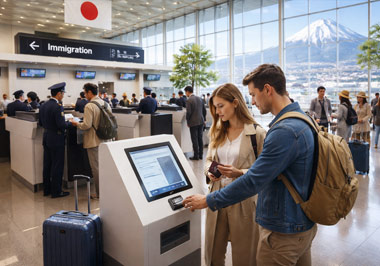
The Japanese government has officially confirmed the creation of JESTA, a new electronic travel authorization system intended for nationals of visa-exempt countries. Inspired by the U.S. ESTA model, this system will allow Japanese authorities to screen travelers before departure. The goal is twofold: strengthen immigration controls and speed up arrival procedures in a context of sharply rising international tourism. According to the Ministry of Justice, the launch of JESTA is now expected by the end of fiscal year 2028, earlier than the initially announced timeline.
🛂 Key points – JESTA Japan
- 🇯🇵 JESTA is Japan’s future electronic travel authorization
- 🧾 It will apply to visa-exempt travelers
- 🌍 Around 71 countries are covered at this stage
- 📅 Launch expected by the end of fiscal year 2028
- ✈️ Goal: strengthen checks and streamline entry procedures
- 🔍 System inspired by the U.S. ESTA model
The Japanese government has confirmed the launch of JESTA in 2028, a new system designed to introduce an electronic travel authorization before departure.
This announcement marks a major change in Japan’s entry requirements. Until now, nationals of many countries could enter Japan visa-free for short stays without any prior online process. With the implementation date for JESTA now set for 2028, that will change.
Authorities explain that JESTA’s entry into force is part of a rollout schedule that is faster than initially planned. The system responds to two key challenges: improving border security and speeding up immigration procedures on arrival, in a country that welcomes a growing number of foreign visitors every year.
JESTA follows the same principle as the well-known U.S. ESTA. It is an electronic travel authorization that travelers will need to obtain before departure, even if they are visa-exempt.
In practical terms, this system similar to the U.S. ESTA will allow Japanese authorities to carry out checks in advance, before boarding.
Japan is therefore joining an international trend already adopted by several major destinations. The aim is not to make travel more complicated, but rather to secure and anticipate checks. For travelers, this mainly means a new administrative step to plan for before a trip to Japan.
If the launch of JESTA has been brought forward, it is largely due to the rise in tourism to Japan.
In recent years, the country has recorded record visitor numbers, with millions of foreign travelers drawn by the weak yen, the post-pandemic recovery, and Japan’s cultural appeal.
This pressure on borders has highlighted the limits of current systems. Entry checks must remain both effective and fast, which becomes increasingly complex as traveler volumes grow. By introducing advance screening via JESTA, authorities hope to better distribute the workload and reduce queues on arrival.
Behind JESTA are two objectives: improving security at Japan’s borders and streamlining entry procedures. The system is intended to allow better screening of travelers before they even board the plane, while simplifying immigration for the vast majority of visitors.
In practice, this should help to:
- 🛂 Strengthen immigration checks in advance
- ⏱️ Speed up entry procedures on arrival
- 🔍 Better anticipate traveler flows
- ✈️ Reduce pressure at airport border checkpoints
For authorities, it is also a modern tool for managing tourist flows, in a context where Japan remains one of Asia’s most attractive destinations.
JESTA will primarily apply to nationals of countries that currently benefit from visa exemption for short stays in Japan. In other words, travelers who can enter Japan today without a visa will, in the future, need to obtain this electronic travel authorization before departure.
The countries concerned by JESTA represent a very large share of international tourism to Japan. For these visa-exempt travelers, the change will not be a visa as such, but an additional online step to anticipate when preparing the trip.
At this stage, Japanese authorities mention around 71 countries covered by JESTA. These are the countries currently exempt from visas for short stays.
The list includes in particular: Germany, Andorra, Argentina, Australia, Austria, the Bahamas, Barbados, Belgium, Brazil, Brunei, Bulgaria, Canada, Chile, Cyprus, South Korea, Costa Rica, Croatia, Denmark, the United Arab Emirates, Spain, Estonia, the United States, Finland, France, Greece, Guatemala, Honduras, Hong Kong, Hungary, Indonesia, Ireland, Iceland, Israel, Italy, Lesotho, Latvia, Liechtenstein, Lithuania, Luxembourg, Macao, North Macedonia, Malaysia, Malta, Mauritius, Mexico, Monaco, Norway, New Zealand, Panama, the Netherlands, Poland, Portugal, Qatar, the Dominican Republic, the Czech Republic, Romania, the United Kingdom, San Marino, El Salvador, Serbia, Singapore, Slovakia, Slovenia, Sweden, Switzerland, Suriname, Taiwan, Thailand, Tunisia, Turkey, and Uruguay.
These international travelers will remain visa-exempt, but will now need to complete this prior step. For foreign nationals, this mainly means a new formality to add to the pre-departure checklist.
For European travelers to Japan, the arrival of JESTA will change habits. Until now, Japan’s entry requirements have been relatively simple for short tourist stays. Going forward, travelers will need to remember to apply for an online travel authorization before leaving.
In practical terms, this means:
- 🧾 A new step to complete before departure
- ⏳ A processing time to plan for in order to obtain the authorization
- 📄 An additional verification of travel documents
- ✈️ More thorough trip preparation
Even if these new entry rules for Japan add a step, they are part of a global trend already seen in many destinations. For travelers, the key will be not to depart without completing this process, or they may be denied boarding.
More and more countries are introducing an electronic travel authorization or online travel formalities to strengthen pre-travel screening of passengers. This evolution responds to a dual requirement: improving border security while streamlining entry procedures for international visitors. Long limited to a few pioneering destinations, these travel e-authorizations and other electronic travel forms are now common tools for managing arrivals.
Asia is a clear example of this shift. Several major destinations have already introduced declaration or authorization systems to be completed before departure. This is notably the case with the Taiwan Arrival Card, which requires an online entry form for Taiwan to be completed before arrival. This type of process allows local authorities to anticipate checks and better manage the reception of travelers.
Thailand has also strengthened its travel formalities with digital procedures, notably the Thailand Digital Arrival Card (TDAC), with the aim of modernizing checks and better managing traveler flows.
In the Philippines, entry requirements include systems such as eTravel Philippines, an online declaration to complete before departure. This type of document helps facilitate health, immigration, and administrative checks on arrival, saving time at controls and improving traveler monitoring.
These examples show that Japan is joining a trend already well established in Asia, where the digitalization of travel formalities has become the norm.
With JESTA, Japan aligns with a pre-departure screening approach already adopted by many destinations. The objective is to anticipate checks and secure entry into the country without adding burdens to arrival procedures.
The principle is simple: screen travelers in advance to identify potential issues before boarding. This pre-boarding screening helps secure borders while avoiding complicated situations on arrival.
For Japanese authorities, JESTA is an online pre-travel procedure designed to modernize the immigration system and adapt to rising visitor volumes. In this context, completing part of the checks in advance helps manage flows more effectively and reduce the workload on arrival.
By adopting this type of system, Japan is following a path similar to other major tourist destinations, where anticipation and digital entry management have become essential tools.
Find out if your question has been answered in the list below
JESTA is Japan’s future electronic travel authorization system for visa-exempt travelers. Inspired by the U.S. ESTA, it aims to strengthen checks before departure and streamline entry into the country. This decision comes amid a sharp rise in tourism and the modernization of immigration procedures.
The Japanese government is planning a launch by the end of fiscal year 2028. JESTA will apply to nationals of around 71 countries that are currently visa-exempt for short stays. These travelers will need to obtain an online authorization before departure, even if they do not need a visa to enter Japan.
JESTA will add a step to trip preparation: an online authorization application before departure. The goal is to prevent boarding issues and simplify checks on arrival. For travelers, this mainly means planning formalities earlier and verifying travel documents before leaving for Japan.