
Thailand Tourist Tax Update
Thailand could soon introduce an €8 tourist tax and reduce visa-free stays to 30 days, directly impacting international travelers.
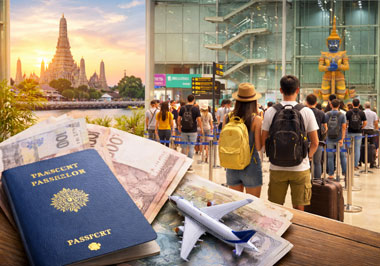
Thailand is considering major changes for international travelers. Between the possible introduction of a 300-baht tourist tax (around 8 euros) and the reduction of the visa-free stay to 30 days, these measures could significantly change the experience of tourists visiting the Kingdom. These announcements come at a delicate time for the sector, marked by slower arrivals, driven in particular by international tensions and rising air travel costs.
👉 This development follows recent discussions about reducing the visa-free stay, already mentioned in our February 13 news update: ➡️ Reduction of the visa-free stay in Thailand
👉 Thailand: key points to remember
- 💰 A 300-baht tourist tax (≈ €8) under consideration
- 📆 Visa-free stay could be reduced to 30 days
- 🌍 Measures aimed at better regulating tourism
- ✈️ Direct impact on European travelers
- ⚠️ No immediate official change yet (still under discussion)
- 📊 Final decision still pending
The Thai government is currently studying the introduction of a tourist tax set at 300 baht (around 8 euros) for travelers arriving by air.
🎯 Stated objective:
- 💰 finance the development of tourism infrastructure
- 🏝️ improve the quality of services
- 🚑 strengthen insurance and assistance systems
However, the measure is dividing tourism professionals.
For Thanet Supornsahasrungsi, president of the Chonburi Tourism Federation, it is still too early to measure the real impact of this tax.
👉 In an already fragile context, he warns of:
According to him, adding a tax could further weigh on travelers’ confidence.
👉 He therefore recommends:
- ⏳ postponing its implementation
- 🌍 waiting for the international situation to stabilize
On the other hand, Ratchaporn Poolsawadee, vice president of the Tourism Council of Thailand (TCT), takes a more nuanced position.
👉 In his view:
👉 In short: the tax would be more symbolic than restrictive
At the same time, the government is considering reducing the duration of the visa-free stay from 60 days to 30 days.
🎯 Objectives:
- ⚖️ better regulate extended stays
- 🚫 combat certain illegal activities
- 🛂 strengthen entry controls
👉 This measure is part of a broader effort to improve regulation.
According to the TCT, this reduction would actually be only slightly restrictive for the majority of tourists.
👉 Why?
- 🗓️ the average length of stay is less than 20 days
- 🌍 most visitors do not stay for 2 months
- ✈️ short stays remain by far the most common
👉 Conclusion: for many travelers, it would not change anything in practical terms
This measure also aims to limit certain illegal practices observed in recent years.
👉 Thailand has recorded:
- 📈 an increase in long-term stays
- 🌍 travel movements linked to international conflicts
- 🚨 illegal activities in certain major cities
Concrete example:
A Russian tourist was recently arrested in Phuket for offering illegal tourism services while holding an unsuitable visa.
👉 Government objective:
Not all travelers are affected in the same way by these proposed measures. Some profiles could be more impacted, including:
👉 For tourism professionals, applying a uniform policy to all visitors would therefore be poorly suited.
In this context, several industry figures believe that the priority should not be to shorten the length of stay, but rather to strengthen controls.
👉 Recommendations put forward:
- 🛂 stricter entry controls
- ⚖️ better enforcement of existing rules
- 🏨 monitoring of unlicensed accommodation
👉 The goal is clear: target abuses without penalizing regular travelers.
In addition, these discussions come at a tense economic time for Thai tourism.
👉 Several factors are currently weighing on the sector:
Faced with these difficulties, the authorities are considering revising their tourism strategy.
👉 Priorities could shift toward:
👉 Regions considered less affected by air travel disruptions.
👉 As of today, none of these measures has yet been officially implemented.
But to prepare for your trip, some steps remain essential:
Between a desire to move upmarket, the need for regulation, and the adaptation to international crises, Thailand is trying to redefine its tourism model.
If adopted, these measures could mark a major turning point in the country’s visitor policy.
👉 It remains to be seen whether they will strike the right balance between attractiveness and control.