
End of the 60-day visa-free stay in Thailand
Thailand is preparing to reduce the visa-free stay duration from 60 to 30 days, marking an important turning point in its tourism immigration policy.
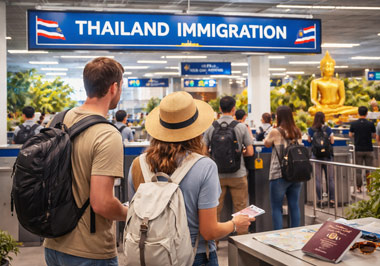
Thailand’s entry policy could soon change for millions of travelers. According to the Bangkok Post, authorities plan to reduce the visa-exemption period, currently set at 60 days, back to 30 days as it was before 2024. This measure would apply to nationals of 93 countries and is mainly intended to strengthen immigration checks and curb abuses linked to long stays. The government nevertheless says the impact on tourism will remain limited, as most visitors leave the country within a month.
🧭 Key points: what will change for travelers in Thailand
- ⏳ The visa-free stay should drop from 60 to 30 days for nationals of 93 countries.
- 🛂 Stated goal: fight abuse, including illegal activities and misuse of tourist status.
- 💰 Paid extensions will remain possible (around 1,900 baht for an additional 30 days).
- ✈️ According to authorities, the impact on tourism will be limited, as most visitors stay less than 21 days.
- 🚨 Checks against visa runs and repeated entries have already been tightened since late 2025.
A reform under discussion that could change travel habits in 2026
Since summer 2024, Thailand has made a strong move to boost its tourist appeal by allowing nationals of 93 countries to stay up to 60 days without a visa. A measure welcomed by travelers, tourism professionals, and anyone who likes to take their time discovering the country—from Bangkok to the southern islands and the mountainous north.
But in early 2026, a shift in direction is emerging. Thai authorities are seriously considering a return to a 30-day visa-free stay, as was the case before 2024. The stated aim is to strengthen immigration controls and limit certain abuses, while maintaining a welcoming policy for international tourism.
⚠️ Important: at this stage, this is a proposal under review, not yet an officially effective rule. For now, the 60-day period still applies, but the reform could be adopted in the coming months.
The 60-day visa-free regime has clearly boosted the country’s attractiveness. However, authorities have found that this system is sometimes diverted from its tourism purpose. Some visitors use these long periods to remain in the country long-term without an appropriate visa, make repeated border runs (the famous visa runs), or carry out activities that do not align with a simple tourist stay.
The government’s idea is therefore to return to a stricter framework without closing the door to travelers. By bringing the visa-free duration back to 30 days, authorities believe it will be easier to:
This approach is meant to be pragmatic: tourism remains a national priority, but within a framework considered better controlled.
In practice, this possible reduction should change little for most travelers. Visitor statistics show that the vast majority of tourists stay in Thailand less than three weeks. In other words, for a classic 10-, 15-, or 20-day trip, moving from 60 to 30 visa-free days changes absolutely nothing.
The profiles most likely to be affected are mainly:
For them, the reform would simply mean planning a bit more ahead: either applying for an extension on site, or choosing a more suitable visa before departure.
Even if the visa-free duration drops to 30 days, extensions should remain possible through Thai immigration. Concretely, a traveler entering visa-free could:
This would still allow a stay of up to 60 days in total, but with an administrative step along the way.
For even longer stays, other options already exist: a standard tourist visa, long-stay visas, or specific schemes depending on the traveler’s profile.
Alongside these discussions about the visa-free stay duration, Thailand has strengthened its entry procedures. Since 2025, travelers have notably been required to complete a digital formality before departure.
This is the online arrival card for Thailand, a mandatory document to be completed before boarding. This step helps authorities better anticipate arrivals, streamline immigration checks, and strengthen border security.
For travelers, it’s mainly a formality not to forget:
One of the points motivating the current reflection concerns visa runs, these quick exits from the country followed by an almost immediate return to get a new entry stamp. While this practice was long tolerated, it is now increasingly monitored, and in some cases refused.
By reducing the visa-free stay duration and tightening checks, authorities aim to:
- discourage near-permanent stays disguised as tourism,
- better distinguish genuine tourists from people who should actually hold another type of visa,
- and clarify the rules of the game for everyone.
For good-faith travelers, this mainly means more clarity and predictability in the process.
As long as the reform has not been officially adopted, the current 60-day visa-free rule remains in force. But it is clearly recommended to:
👉 If your trip is less than 30 days:
Nothing changes, even if the reform takes effect.
👉 If your trip is between 30 and 60 days:
You will likely need to plan for an on-site extension.
👉 If your stay exceeds 60 days:
It’s best to plan an appropriate visa before departure to avoid any surprises.
It is important to stress this: this evolution does not represent an anti-tourist crackdown. On the contrary, Thailand remains one of Asia’s most welcoming countries, with a wide range of visa options and a clear willingness to remain a major global tourism destination.
The philosophy seems rather to be:
- make entry easier for genuine tourists,
- while preventing the visa-free regime from being used to bypass the rules.
In this sense, the return to 30 visa-free days fits more into a balancing act than a closure.
Find out if your question has been answered in the list below
No, for now the 60-day visa-free rule is still in force. Thai authorities have announced they are working on a reform to return to 30 days, but no official implementation date has yet been confirmed. It is therefore a change under discussion, which travelers should monitor before departure.
Most tourists should not be affected, as the majority of stays in Thailand last less than three weeks. However, travelers who stay longer than a month—such as some digital nomads or long-stay travelers—will likely need to plan a stay extension or apply for a suitable visa before departure.
Yes, even if the visa-free duration is reduced to 30 days, it will remain possible to apply for a stay extension through Thai immigration. This extension generally allows you to add an additional 30 days for a fee. For longer stays, it will still be recommended to choose a specific visa before traveling.