
China eVisa: towards simplified entry procedures
China is considering an eVisa and accelerating the digitalization of entry procedures, with online applications, a digital arrival card, and expanded visa exemptions.
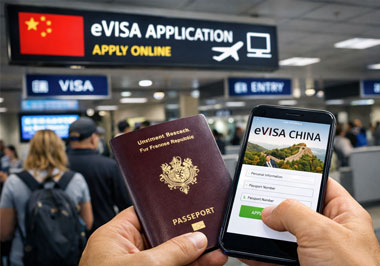
China is beginning a major transformation of its entry policy. In an official statement published on March 20, 2026, the authorities mentioned for the first time the possible introduction of an eVisa, with a fully online application process and shorter processing times. This development is part of a broader strategy aimed at reviving international tourism, simplifying entry formalities and improving the experience of foreign visitors. At the same time, Beijing plans to expand visa exemptions, generalize the digital arrival card and modernize reception services to strengthen its attractiveness.
🧾 What you need to know about the China eVisa project
- 🟢 China is officially studying the introduction of an eVisa (electronic visa)
- 🌐 An online visa application could be tested soon
- ⏱️ Goal: reduce processing times
- 📲 The digital arrival card is expected to become the new standard
- ✈️ Visa exemption continues to expand to new countries
- 🧳 Entry formalities will be gradually simplified
- 💳 Overall improvement of the traveler experience (payment, services, languages)
This announcement could permanently transform access to Chinese territory. In their statement, the authorities say they want to “study the implementation of an electronic visa, test online applications and shorten processing times.”
Until now, China has remained an exception among major tourism powers. Unlike destinations such as Thailand, the United States or the United Kingdom, it has mainly relied on a physical visa system requiring procedures through approved visa centers.
The possible introduction of an eVisa would therefore represent a major structural change. For travelers who are subject to visa requirements, this would mean:
- 🧾 less paperwork
- 📩 a simplified procedure
- ⏳ potentially shorter processing times
- 📲 a fully online process
However, the authorities remain cautious. No precise timeline has been announced at this stage, which suggests that the project is still in a study and testing phase.
The eVisa project is only one part of a much wider plan. The stated objective is clear: strengthen China’s appeal to foreign visitors and stimulate tourism spending.
To achieve this, Beijing is relying on several levers:
- 🌏 creation of a national tourism brand around the concept “Hello! China”
- 🎯 targeted promotional campaigns in international markets
- 🧳 development of multi-destination travel routes
- 🎓 promotion of educational and cultural tourism
- 🌿 creation of sustainable tourism offers
The authorities also want to encourage stays combining transport, accommodation, visits and experiences in order to increase visitor spending on site.
Another important focus is adapting to the habits of international travelers. This includes better use of social media, the use of artificial intelligence and the digitalization of tourism infrastructure.
Alongside the eVisa project, China is accelerating the digitalization of its entry procedures with the generalization of the digital arrival card, the China Arrival Card to complete online.
Introduced at the end of 2025, this system allows travelers to fill in their information online before arrival. It is part of an effort to streamline border checks and reduce waiting times.
In practical terms:
The authorities now want to strongly promote this system, which is expected to gradually replace paper forms.
However, alternative solutions remain available during the transition period:
This gradual approach ensures that travelers who are less comfortable with digital tools are not excluded.
Alongside these developments, China is confirming its intention to ease entry conditions, particularly through the expansion of visa exemption.
Today, many countries already benefit from this measure, allowing visa-free stays of up to 30 days for tourism, business or family purposes.
The authorities say they want to:
- 📈 gradually expand the list of eligible countries
- 🔄 optimize visa-free transit schemes
- ⚡ simplify administrative procedures
This strategy aims to make the destination more accessible, especially for short stays.
It is also part of an international competition logic. Many destinations have already simplified their entry formalities in recent years, and China is now seeking to align itself with that level.
Beyond visas, the plan unveiled by the Chinese authorities aims to completely rethink the experience of foreign visitors.
Several improvements are being considered:
- 🌐 development of services in foreign languages
- 💳 easier international payments
- 🏷️ improved tax refund systems
- 📶 better connectivity (internet, telecommunications)
- 📍 multilingual signage in public places
The authorities also want to encourage local applications (transport, payment, services) to offer versions adapted to international visitors.
The objective is clear: reduce the friction experienced by tourists and make their stay smoother.
With this series of measures, China is sending a strong signal: that of a gradual and controlled opening toward international travelers.
The eVisa project, although still under consideration, could become a central driver of this transformation. If implemented, it would significantly simplify access to the territory and align China with international standards.
In the meantime, the combination of several measures — visa exemptions, digital arrival card, simplified procedures — shows that the momentum is already underway.
For travelers, this could mean in the medium term:
- ✈️ simpler procedures
- ⏱️ shorter processing times
- 📲 a fully digital experience
What remains to be seen now is when and how this China eVisa will become reality. One thing is certain: the transformation has begun. 💥
Find out if your question has been answered in the list below
Chinese authorities have indicated that they are studying the introduction of an eVisa as part of new measures on entry formalities. The project is still in the reflection stage and no precise schedule has been announced at this point.
No official date has been announced so far. The China eVisa is still only a project, with testing phases expected before any possible rollout.
The eVisa is expected to apply to travelers who are currently subject to visa requirements. However, the exact rules, the countries concerned and the eligibility conditions have yet to be defined.