
Malawi Visa online
Since January 2026, the Malawi visa has become mandatory again for many nationalities, marking a clear reversal of the visa exemption policy introduced in 2024.
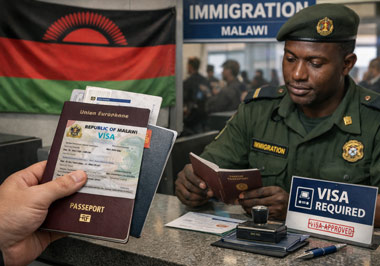
Since 3 January 2026, Malawi has significantly changed its entry rules. After a wide opening in 2024, the Malawian government decided to restrict its visa exemption policy. From now on, many travellers who were previously exempt — including French, Belgian, Canadian, American or British nationals — must obtain a visa before departure. This reform is based on a principle of diplomatic reciprocity, aligning Malawi’s entry conditions with those applied to its own citizens abroad. Travel formalities are therefore changing significantly for international visitors.
🧭 Malawi visa: what you need to know in 2026
- 📅 New rule in force since 3 January 2026
- ❌ End of visa exemption for many countries, including France
- 🌍 Policy now based on diplomatic reciprocity
- 🛂 Visa required for nationalities not listed as exempt
- 💻 Online visa application possible via the official e-Visa portal
- ⏳ Portal still being updated to reflect the new regulations
- 💵 Visa fees range from USD 50 to USD 250 depending on type and duration
Since 3 January 2026, Malawi has implemented a major reform of its immigration policy. After widely easing its entry rules in 2024, the country is making a strategic U-turn by reinstating the requirement for a Malawi visa for many nationalities that were previously exempt.
This decision directly affects international travellers, including nationals of France, Belgium, Canada, the United States or the United Kingdom, who must now obtain a visa before departure to enter Malawi.
This tightening is not the result of a sudden decision. As early as November 2025, Malawi’s Minister of Finance, Joseph Mwanamvekha, had announced the government’s intention to review entry conditions for certain foreign travellers.
🗣️ During the 2025-2026 mid-term budget review, he mentioned the revocation of visa-free access, with implementation expected in the short term.
Although the measure was not implemented immediately, it was already clearly set out in the executive’s strategic directions.
The reform was officially confirmed by a text published in the Malawi Gazette Supplement dated 2 January 2026. This publication amends immigration regulations and redefines the list of nationalities exempt from a Malawi visa.
📌 In its official communication, the government states that it has:
« revised its visa regime, which came into force on 3 January 2026. Under the new regime, only countries belonging to the same regional blocs as Malawi or those that do not require visas for Malawian nationals remain exempt ».
Malawi is now adopting a visa policy based on diplomatic reciprocity. In practical terms, if a country requires visas for Malawian citizens, its nationals will also have to apply for a Malawi visa to enter the country.
Any nationality not included in the official exemption lists is therefore subject to a prior visa requirement.
Despite this tightening, some exemptions remain. Nationals of the following countries can still enter Malawi without a visa:
🌴 Antigua and Barbuda, Bahamas, Barbados, Belize, Benin, Dominica, Ecuador, Fiji, The Gambia, Ghana, Grenada, Haiti, Hong Kong, Jamaica, Kiribati, Malaysia, the Philippines, Singapore, Saint Lucia, Saint Vincent and the Grenadines, Trinidad and Tobago, and Vanuatu.
These exemptions are mainly based on bilateral agreements or on the absence of visa requirements imposed on Malawian nationals.
Certain regional and institutional categories also benefit from a specific regime, subject to the principle of reciprocity.
🏛️ Exempt from a Malawi visa are:
⚠️ These exemptions do not apply to standard tourism.
This reform marks a radical change compared with the policy implemented less than two years earlier.
In February 2024, Malawi had removed visa requirements for 48 countries in order to boost tourism and foreign investment.
🌍 Among the countries that were exempt at the time were:
France, Germany, Belgium, Italy, Spain, the Netherlands, the United Kingdom, Canada, the United States, Australia, New Zealand, Sweden, Norway, Portugal, Poland, Russia, China, Israel, Singapore, Malaysia, as well as several Caribbean and Pacific states.
Since 3 January 2026, citizens of these countries must once again apply for a Malawi visa before travelling.
This decision is part of a regional trend observed in Southern Africa. Like Namibia, Malawi is now favouring an balanced and reciprocal entry policy rather than unilateral openness.
🎯 Possible objectives include:
rebalancing diplomatic relations,
strengthening control of migration flows,
aligning entry conditions with those imposed on Malawian citizens abroad.
Since 2019, Malawi has offered an e-Visa, allowing applications to be made entirely online via the official portal.
🖥️ The process covers in particular the Malawi tourist visa, the transit visa and multiple-entry visas.
⚠️ Warning: at this stage, the official portal still shows some nationalities as exempt, even though the regulations have changed. The authorities indicate that the site is being updated.
👉 It is recommended to check the information regularly before starting an application.
Malawian authorities have communicated the following official fees:
Fees vary depending on the validity period and the number of permitted entries.
Find out if your question has been answered in the list below
Yes. Since January 3, 2026, a Malawi visa has been required for most foreign travelers. Citizens of many countries that were previously exempt, including France, Belgium, Canada, and the United States, must now obtain a visa before departure, unless they are on the official list of countries that are still exempt.
Yes. Malawi has been offering an electronic visa (e-Visa) since 2019. Applications are made online via the official portal of the Malawian authorities. However, the site is still being updated and may display outdated information regarding certain exemptions that have recently been removed.
The cost of a Malawi tourist visa depends on its duration and the number of entries allowed. A single-entry visa (valid for three months) costs $50. Multiple-entry visas are available for $150 for six months and $250 for twelve months, according to the official rates provided by the authorities.